The picture painted of the Creator Economy is pure idyll: work in pyjamas, answer to nobody, and monetise your morning coffee.
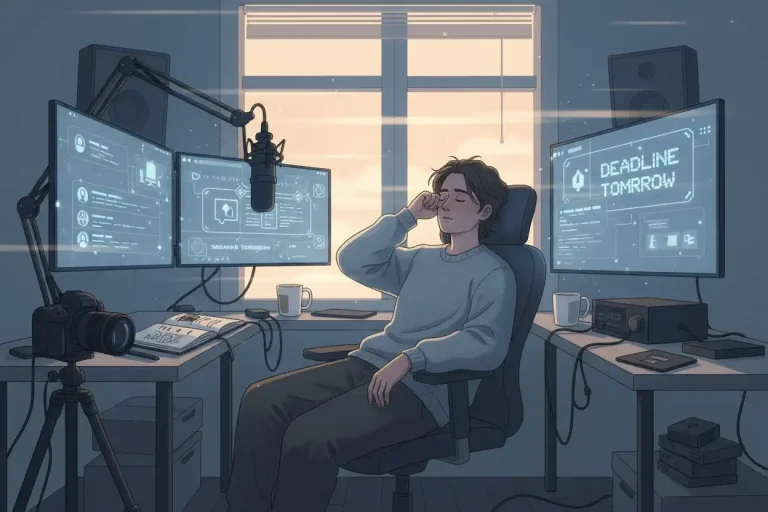
But scratch the ring‑light gloss and another story emerges — one about exhaustion, anxiety, and the slow erosion of joy.
For every #Blessed creator celebrating a milestone, there’s someone else quietly wondering if their next upload will be the one that breaks them.
The illusion of freedom
From the outside, independence looks therapeutic. No boss. Flexible hours. Global audience. In practice, creative self‑employment has turned into a 24‑hour shift. There’s no off‑switch because downtime risks invisibility. Algorithms have appetites of machines: they feed on consistency and punish silence.
When your livelihood depends on visibility, you don’t log off; you refresh. “Going dark” for a week feels rebellious — until you watch engagement plummet. So creators post through illness, weddings, grief, jet‑lag, and New Year’s Day hangovers. If librarians judged worth in borrowed books, creatives are now judged in watch‑time.
The psychological toll isn’t theoretical. Researchers are reporting burnout patterns in full‑time creators that mirror those found in overworked medics: insomnia, depersonalisation, and a sense that you’re merely content about your content.
The pressure of the performance self
The great twist of the Creator Economy is that your product is you. Unlike office workers, you can neither step away from your “brand” nor clock out of your personality. A bad day can’t be contained inside Slack; it leaks straight into the timeline.
This perpetual self‑presentation breeds a strange fatigue — less physical, more existential. Your sense of identity depends on public affirmation. The dopamine loop of likes keeps motivation saddled to metrics. Take them away and you risk creative vertigo: If nobody reacts, am I even still creative?
What looks like confidence online is often armour. A creator’s smile during a livestream sometimes hides the panic of falling CTRs (click‑through rates, for the uninitiated). Behind each seemingly casual short sits hours of scripting, editing and algorithm watching. Even comedians start measuring laughs by retention graphs.
When passion becomes productivity
“Do what you love and you’ll never work a day in your life,” someone once lied.
Turning passion into paycheck commodifies the very thing that once soothed you. A painter who created for escape now tracks colour‑grading metrics; a violinist rehearses TikTok hooks. Play becomes labour disguised as leisure.
Many creators admit privately that they rarely consume media for pleasure anymore — every video is research, every scroll reconnaissance. The line between inspiration and output dissolves, and with it the joy of discovery.
The economics of exhaustion
Why persist? Because the margins are thin and attention is fragile. A week off can translate into lower ad‑revenue, fewer sponsorships, lost momentum. When success depends on remaining visible, rest looks reckless.
Most traditional professions have built‑in rest stops — weekends, holidays, PTO. In the Creator Economy, you must design your own infrastructure of sanity. Few do. The cultural script still romanticises grind: the mythic figure editing at 3 a.m. with cold coffee and visionary drive. In reality, that’s not passion; it’s cortisol.
And burnout doesn’t just harm individuals — it stifles the entire ecosystem. Fatigued creators recycle concepts. Audiences sense creative drag. Quality drops, trust dips, platforms fill with noise.
Towards sustainable creativity
A healthier model begins with boundaries that treat the creator as employee and employer. Employees require rest; employers must enforce it. That means:
- Scheduled hiatuses: announce breaks publicly so algorithms don’t define them as death.
- Content batching: shoot in sprints; schedule releases automatically.
- Real weekends: even robots need maintenance.
- Peer collectives: small groups of creators swapping workload or offering backup when one burns out.
The future may involve “collective channels” where several creators share audiences and revenue, letting individuals disappear without vanishing. Think co‑ops for content.
What platforms can fix
While self‑care rhetoric swirls endlessly, structural reforms lag. Platforms could buffer revenue dips during planned breaks, or prioritise mental‑health partnerships similar to corporate EAPs. Creators Fund bonuses could reward quality metrics — viewer satisfaction, not output volume. Small algorithmic empathy could yield big human benefit.
Ultimately, though, cultural change must precede code change. Audiences can help simply by reducing entitlement: responding to creator absences with grace instead of guilt‑tripping comments. Silence can be performance art too.
The quiet rebellion
One of the year’s quietest trends is creators experimenting with invisibility. Posting less, saying more. Limiting collaborations. Deleting apps off weekends. They’re discovering that when you treat attention as a resource instead of an identity, creativity returns refreshed. The best way to beat the algorithm might actually be to ignore it — for a while.
The takeaway
Creator burnout is not a sign of weakness but of system design. You cannot run perpetual motion on human emotion. The work that once promised liberation threatens to replicate the very grind it replaced.
The next revolution in the Creator Economy won’t be technological — it’ll be humane. Sustainability isn’t about carbon footprints; it’s about mental ones. After all, a rested creator tells better stories, and storytelling remains the one renewable energy source no machine can replicate.