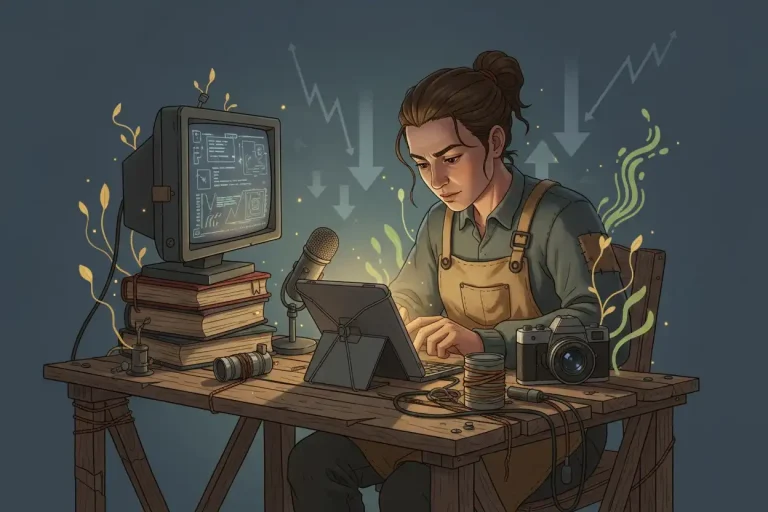
When markets shiver, marketing budgets are the first to reach for a coat. And because the Creator Economy runs largely on those budgets — brand deals, sponsorships, ad revenue — every downturn brings an echo of dread. Yet recessions have an odd relationship with creativity: they squeeze excess, expose dependence, and often spark the most inventive chapters. Hard times make sharper storytellers.
The fragility test
The Creator Economy built itself on optimism: frictionless tools, permanent connectivity, cheap attention. But optimism is seasonal. When economic chill sets in, advertisers retreat, consumer confidence dips, and CPMs collapse. For creators, that means sponsorship droughts and smaller cheques.
In 2020, many faced the paradox of record views but reduced income: brands paused campaigns even as audiences grew captive. The lesson is still echoing — visibility alone doesn’t guarantee viability. If your business relies entirely on others’ marketing budgets, you’re essentially subcontracted to corporate mood swings.
A downturn doesn’t abolish the Creator Economy; it audits it. It distinguishes those who built audiences from those who merely rented them.
Why audiences still spend — differently
Recession doesn’t kill demand for entertainment or guidance; it reshapes it. When money is tight, people buy fewer luxuries but crave value. They seek creators who inform, soothe, or teach useful skills. Practical magic replaces pure spectacle.
That’s why education channels, DIY culture, and personal‑finance storytellers often flourish in recessions. They turn uncertainty into currency. Audiences want reassurance from familiar voices, not slogans. In turbulent times, personality is the new stability.
For creators, the challenge is tone. Hard‑selling feels tone‑deaf when followers face job cuts. Soft honesty — acknowledging hardship while offering usefulness — earns loyalty. Empathy converts better than urgency.
Diversifying the safety net
Economic downturns expose how single‑threaded most creator incomes remain. Ad revenue and brand deals dominate; few diversify until forced. But the smartest creators treat contraction as prompt, not punishment.
Direct support systems — Patreon, Ko‑fi, paid newsletters — bloom during recessions precisely because fans prefer to stabilise their favourite voices. A modest subscription feels like civic duty. When the brand money dries, the community income often holds.
Other hedges: workshops, e‑books, digital templates, coaching. None rely on external ad budgets; they’re rooted in audience relationship rather than reach. A recession becomes less career threat, more creative constraint.
Rethinking scale
Downturns quietly reward smallness. Lean teams pivot faster; solo operations carry less overhead. The creators who survive aren’t always the biggest, but the most nimble. A single person with loyal fans can adjust pricing, format, or posting cadence overnight — try getting a conglomerate to do that.
Scale isn’t wrong; it’s expensive. Agencies, editors, merch drops and rented studios amplify potential profits, but they also multiply risk. When income halves, every retained cost becomes ballast. The next evolution of creator business may borrow from slow fashion: fewer launches, higher quality, deliberate cadence.
Corporate retreat, creative bloom
Every crisis since the Great Depression has birthed a creative renaissance. When corporations retreat from bold marketing, independent voices fill the vacuum. They experiment without committees, producing tone and candour unattainable in boardrooms.
We saw it in 2008 with independent blogs; again during the 2020 lockdown wave of micro‑channels. Constraints push experimentation: lo‑fi aesthetics, intimate storytelling, community collaborations. In a perfect twist, hardship revives authenticity — the very substance audiences crave.
Emotional recession
Economic pressure amplifies burnout risks already humming in the Creator Economy. Constant visibility feels heavier when survival anxiety joins the algorithmic one. Creators must manage not just finances but fear.
The solution isn’t toxic positivity; it’s realistic pacing. Sharing uncertainty humanises creators rather than weakens them. Audiences don’t expect influencers to radiate prosperity during global inflation; they expect honesty and solidarity.
The empathy dividend
In downturns, content that comforts can be just as valuable as content that informs. A podcast that feels like conversation, a vlog that offers gentle escapism — these become micro‑sanctuaries. Brands eventually notice and return, seeking precisely that trust pipeline. The creators who kept care in circulation prosper when optimism rebounds.
The takeaway
Recession is brutal but clarifying. It strips the Creator Economy back to its core: genuine connection generating real value. If your worth relies purely on ad spend, volatility will expose it. If it relies on community and creativity, crisis merely recalibrates it.
Tough seasons remind creators that their true assets aren’t CPMs or sponsorships; they’re skills, adaptability, and the loyalty of humans who want to hear from them even when the market doesn’t. Storms don’t end journeys — they test who actually learned to sail.