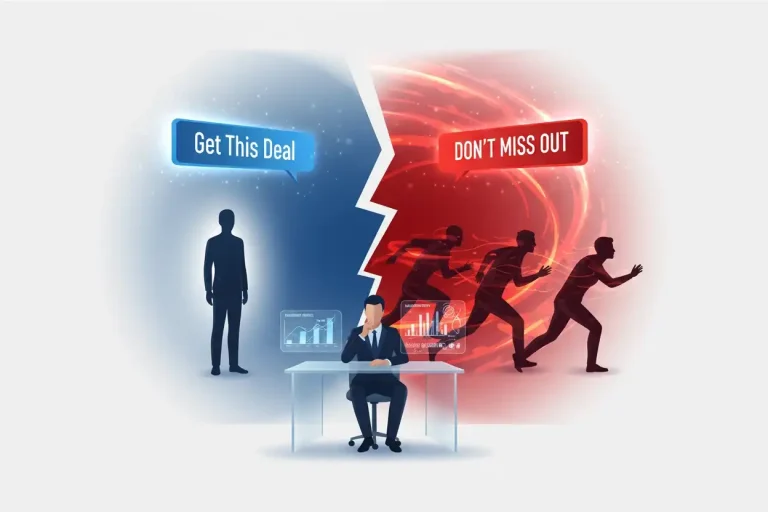
If rational shopping really existed, marketers would be out of work. Thankfully, the human brain runs mostly on emotion—and one emotion rules them all: the fear of loss. That’s the psychological engine behind loss aversion, the principle that makes “Don’t miss out” sound far more persuasive than “Get this deal.”
Loss aversion is a behavioral bias first defined by Daniel Kahneman and Amos Tversky’s prospect theory—people dislike losing about twice as much as they enjoy gaining. In plain English: avoiding pain feels better than chasing pleasure.
This guide explores why it works, the emotional math, ethical tactics, recovery from overuse, tools, and the balance. By the end, you’ll wield loss aversion to nudge decisions without manipulation. Let’s avoid the loss.
Step 1: Why Loss Aversion Works
When customers feel something slipping away—a sale, an opportunity, or even social approval—their motivation spikes. Fear of missing out (FOMO) has become modern fuel for impulsive decisions. A 2025 report found that 60% of millennials make purchases within 24 hours of experiencing FOMO, and nearly 7 in 10 experience it weekly.
Our brains treat missed chances as losses, not neutral events. Limited-time deals, “low stock” banners, and countdown timers all trigger an emotional heat that logic rarely cools. Good marketers don’t invent fear; they focus it.
Step 2: The Emotional Equation
Psychologically, gain framing (“Save £20 today”) sparks mild interest. Loss framing (“Don’t lose your £20 discount”) sparks action. The discomfort of imagined loss often outweighs the promised satisfaction of a reward.
This explains why “Only three spots left” beats “Reserve your spot now”—urgency reframed as potential loss creates frictionless conversion. Brands like Amazon literally bake loss aversion into the interface with “Only 2 items remaining” and lightning-deal countdowns—micro-anxieties disguised as value.
Step 3: How to Harness Loss Aversion – Without Manipulation
Used responsibly, loss aversion doesn’t scare customers; it clarifies stakes. The key is ethical urgency: transparent time limits, genuine scarcity, and avoid fake countdowns that reset hourly (a fast path to lost trust).
Reframe Value as Preventable Loss:
Instead of “Try our premium plan,” highlight what inactivity costs: “You could be losing £200 a month in unclaimed features.”
Use Expiration as Motivation:
Mark deadlines clearly—”Offer ends midnight Sunday” feels real; “Limited availability” feels vague.
Personalize the Stakes:
Behavioral data enables precision nudges: retarget cart abandoners with “Your saved items expire in 24 hours.” Loss becomes specific, not abstract.
Show Real-Time Proof:
Social proof amplifies scarcity’s effect. Wisernotify and similar tools display live purchases (“5 people bought this in the last hour”), turning individual hesitation into shared urgency.
Step 4: Recovery After Overkill
Fear sells—until fatigue sets in. If spammy countdowns or repeated “final offers” backfire, pull back. Reintroduce risk-free trials, money-back guarantees, or assurances that reduce perceived danger instead of amplifying threat. Humans eventually rebel against constant FOMO; balance urgency with security.
Step 5: Loss Aversion Tools to Try
- Wisernotify: Adds real-time urgency via recent purchase pop-ups.
- Optimonk: Designs FOMO-driven exit messages without harming UX.
- ConvertCart: Tests competing offer framings (“Save now” vs. “Don’t lose savings”).
- Deadline Funnel: Synchronizes genuine multi-page countdowns.
- A/B Smartly: Measures whether negative vs. positive framing converts better.
Wrap-Up: The Fine Line Between Push and Panic
Great marketers use psychology to guide action, not guilt. The art of loss aversion lies in empathy—showing what customers stand to forfeit if they hesitate, not frightening them into buying.
So next time you’re tempted to lead with “Get this deal,” try “Don’t miss your chance.” You’ll be speaking your audience’s primary language—survival.