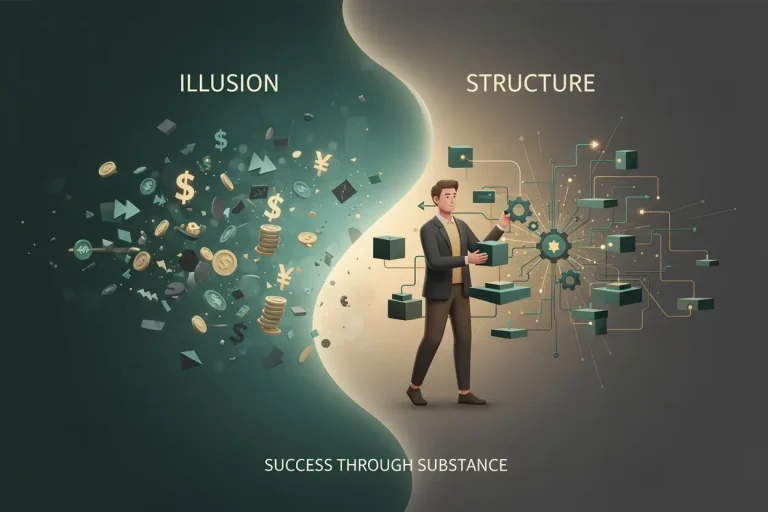
There’s a modern myth doing laps on YouTube: a person in a hammock checks their phone and makes money while birds applaud. It’s the dream of passive income — profit without participation, riches by autoresponder.
Reality: nothing starts passive. Everything “hands‑off” begins terrifyingly hands‑on. If you skip the work of systems, you just build expensive daydreams.
The mythology of “set‑and‑forget”
Books and gurus sell the fantasy because it photographs beautifully. But each “effortless” business hides scaffolding: automations, content pipelines, support SOPs, legal compliance, and endless testing. Passive income isn’t an escape from effort; it’s an investment in infrastructure.
As one veteran marketer put it, “You earn your automation with sweat equity.”
1. Think “system income,” not “passive income”
Systems compound while humans nap. Whether you sell templates, online courses, or subscription widgets, your goal is repeatability — an ecosystem that runs on clarity, not charisma.
Ask: What steps repeatedly drain my time? Then document them. Automation begins with observation, not software.
2. Start with a single predictable sale
No funnel can automate chaos. Before automation, prove one reliable way to sell one product to one specific customer. Record that process end‑to‑end — how they first heard of you, what convinced them, what obstacles appeared.
That’s your “alpha funnel.” Everything else — ads, sequences, upsells — scales that clarity.
3. Design funnels backwards
Most people begin at the top, obsessing over ads. Pros start at the bottom: the moment of transformation. What outcome or delight does the user finally receive? Trace steps backward until you find where strangers first appear.
This reverse engineering ensures the funnel serves reality, not fantasy. The goal isn’t traffic; it’s conversion flow that feels inevitable.
4. Automate insight, not ignorance
Tools like Zapier, ConvertKit, or HighLevel can feel magical — until you debug at 2 a.m. Automation magnifies mistakes. Every broken form or unsubscribed flow is a reminder: automate only what you understand manually.
Build check‑ins: automatic reports that tell you where humans must still peek. The best “passive” entrepreneurs stay quietly alert.
5. Diversify revenue temperamentally, not trendily
Affiliate links, ebooks, micro‑courses, membership access — all fine, but only if they share audience DNA. Random passive experiments dilute trust. Each offer should feed, not fight, your ecosystem.
Think ecosystem, not menu. A garden grows better than a buffet.
6. Turn knowledge into assets
Every process you’ve mastered — client onboarding, proposal writing, cold‑emailing — can evolve into a small digital product. Document once, sell forever. But update annually. Stale wisdom kills repeat sales; fresh examples resell themselves.
Passive income is really maintained leverage.
7. Add customer loops
The most stable funnels are conversational. Exit surveys, NPS forms, community forums — these create constant user inputs that refine the system. Without feedback, your autopilot plane slowly drifts.
Passive doesn’t mean distant. Stay close to signal; delegate noise.
8. Watch the decay curve
Every funnel decays: ads fatigue, copy dates, tech APIs break. Schedule quarterly audits labelled “funnel hygiene.” It’s digital housekeeping — clean lists, refresh visuals, retire outdated bonuses.
Sustainable passive income is really predictable maintenance.
9. Metrics that matter
Ignore the guru scoreboard of “email subscribers” and “views.” Track active buyers, repeat purchase percentage, and refund rate. Those numbers tell truth from theater.
Funnels that serve customers, not algorithms, convert longer.
The takeaway
Passive income is not laziness rewarded; it’s structure matured. It asks you to front‑load wisdom and codify it so money and meaning flow while you focus elsewhere.
Do the deliberate work once — design the funnel, document maintenance — and one day the hammock fantasy might even be half‑true. You’ll just nap knowing why the birds are applauding.