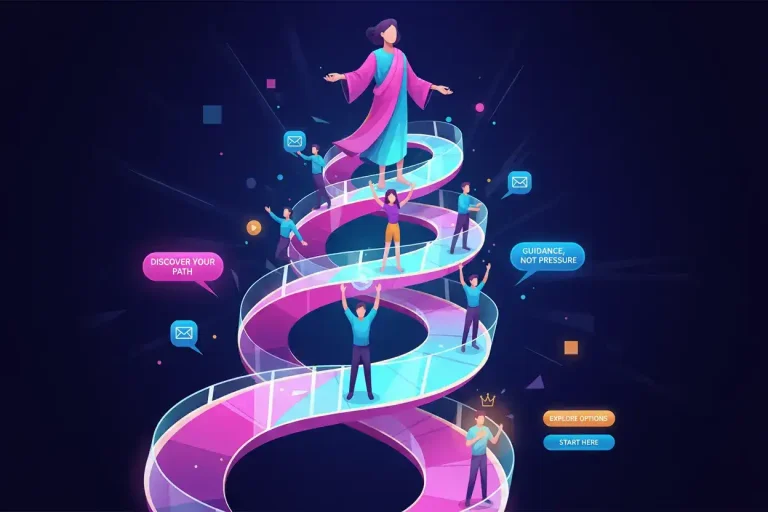
Sales funnels have an image problem. For many people, the word itself conjures sleezy countdown timers, fake urgency bars, and inboxes that feel like hostage negotiations. But sales architecture isn’t the enemy; manipulation is.
A funnel — done well — is just guided generosity: helping someone move from curiosity to confidence without feeling conned. Let’s build that kind.
The empathy blueprint
Forget “tricks.” Start with empathy maps: who your audience is, what frustrates them, what joyful future your offer unlocks. If you can capture that tension — current discomfort ↦ desired relief — the funnel writes itself.
Good marketing isn’t persuasion; it’s permission.
1. The handshake, not the ambush
Your top‑of‑funnel (TOFU) content should feel like hospitality, not entrapment. Genuine teaching posts, free mini‑guides, or podcasts that solve something now create debt‑free goodwill. The opener to any funnel is a handshake: respect first, pitch later.
If a stranger leaves your landing page more informed than when they arrived, you already sell better than half the internet.
2. Clarity beats cleverness
Marketers love fancy words — prospects don’t. Your landing copy should state: who this is for, what it does, what happens next. Ambiguity smells like trickery.
Clarity is kindness; it shortens anxiety loops and lets buyers decide rather than defend.
3. Make discovery easy to leave
Counter‑intuitive truth: permission to exit increases trust. Visible unsubscribe links, clear cancel policies, minimal data capture — all lower risk and reduce resistance. When customers sense freedom, conversion increases.
Ethical funnels never use friction as cage walls.
4. The middle: education, not escalation
Mid‑funnel (MOFU) sequences often devolve into desperation — “This deal expires in 6 minutes!” Real empathy educates instead: layered case studies, behind‑the‑scenes stories, objections answered openly.
When you teach through nurture emails, you prove expertise and care simultaneously. Authority becomes ambient.
5. Testimonials with humility
Social proof still works, but tone matters. Show genuine transformations, not worship. Quotes like “This helped me finally …” humanise; “They’re a genius rockstar wizard” alienates. Future buyers relate to peers, not prophets.
6. Active choice architecture
Design CTAs as invitations, not ultimatums. “Join us if this feels right for your stage” converts better long‑term than “Only idiots miss this!” Respect drives repeat purchase; coercion drives refunds.
The mark of a healthy funnel: your buyers thank you after paying.
7. Follow‑up without fatigue
Sequences exist to reassure, not harass. Space emails organically — imagine chatting with a polite friend, not a clingy bot. Automation logic (“if opened → pause 2 days, if ignored → send quieter reminder”) expresses emotional IQ digitally.
Frequency fatigue is the silent churn. Err on grace.
8. Ownership after purchase
Most funnels end at payment; ethical ones begin there. Use onboarding emails to empower new users: walkthroughs, best‑practice tips, warm welcomes. The quicker they succeed, the faster you’ll re‑earn trust for upgrades later.
Retention is the sequel to persuasion.
9. Design aesthetics that calm
Visual tone affects conscience. Use whitespace, slower scrolls, gentle motion. People read slower when relaxed — exactly what an honest funnel wants. Avoid red urgency banners unless an actual meteor’s coming.
Your layout is psychology. Make serenity your conversion strategy.
10. Measure satisfaction, not just sales
Track open rates, sure — but also “Would you recommend this experience to a friend?” Feedback at each stage turns data into ethics.
Funnels that listen become loops of learning; those that don’t become noise machines.
The takeaway
A sales funnel is a conversation stretched through time. Each touchpoint should feel like thoughtful follow‑up, not a closing tactic. When you design with empathy, transparency, and genuine teaching, conversion becomes collaboration.
Leave the pressure tactics to algorithms; yours should feel like guidance you’d happily give your grandmother. Because the only funnel worth building is one that earns gratitude as efficiently as revenue.