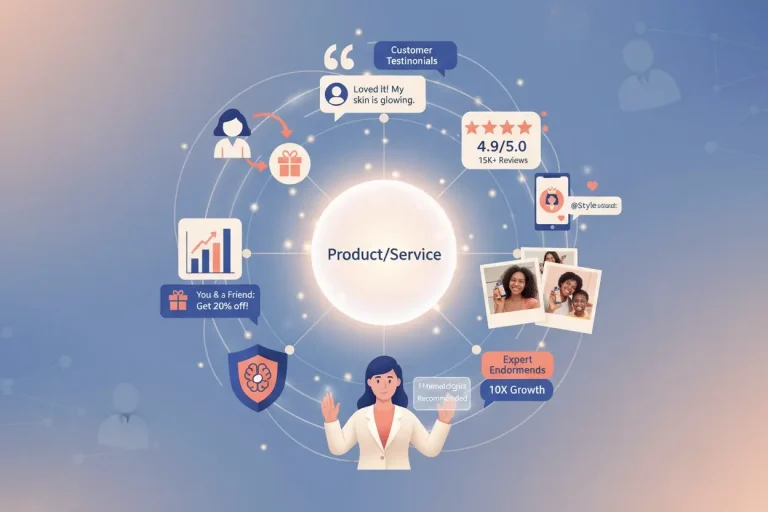
If one person loves a product, it’s interesting. If a thousand do, it’s irresistible. Social proof—the human tendency to copy others’ actions when we’re uncertain—remains one of marketing’s oldest and most reliable persuasion tools. In 2025’s trust-scarce digital world, buyers no longer believe brand promises alone—they believe people like them.
This guide explores why social proof works, the 7 types that sell, building a flywheel, ethical use, tools, and the takeaway. By the end, you’ll deploy proof that drives sales ethically. Let’s prove it.
Step 1: Why Social Proof Works
Social proof taps a deep survival instinct: we assume safety in numbers. It’s why five diners in a restaurant draw a crowd while an empty one stays empty. On websites, the same logic applies—a “4.8 ⭐ rating from 2,000 reviews” or “Trusted by Fortune 500 teams” instantly validates decision-making.
Psychologists call this informational conformity: when uncertainty rises, observation guides judgment. In e-commerce, that means potential buyers browse reviews, case studies, and follower counts to confirm they’re not making a mistake.
A 2025 study showed that social proof messaging can boost conversions by 20–40%, especially when paired with genuine, recent, and visual user evidence.
Step 2: The 7 Types of Social Proof That Sell
1 User Reviews and Ratings:
Still the gold standard. Over 90% of shoppers read reviews before purchasing, and star averages below 4.0 can halve sales. Embed prominent, filterable reviews directly under product titles, not buried at the bottom. Encourage honest feedback—volume signals credibility more than perfection does.
Tools: Yotpo, Judge.me, Trustpilot
2 Testimonials and Case Studies:
Story-driven proof humanises your brand. Use measurable detail (“Revenue up 32% in 60 days”) and real names or photos for authenticity. Mini case studies on landing pages work especially well for B2B services.
Tools: Taggbox UGC, Boast.io, Canva Case Study Templates
3 Influencer and Expert Endorsements:
People trust authority figures who validate their choices. A dermatologist recommending skincare carries more weight than any slogan. Focus on micro-influencers (1k–50k followers) for cost-effective engagement and better alignment with niche audiences.
Tools: Aspire IQ, Upfluence, Trend.io
4 “Wisdom of the Crowd” Signals:
Humans chase popularity. Badges like “Best-seller,” “Most Loved,” or “Trending Now” trigger the fear of missing out (FOMO). Highlight sales milestones (“10,000+ copies sold”) and live indicators of activity (“3 people are viewing this now”).
Tools: Fomo, Nudgify, Proof Pulse
5 Social Media Proof:
Followers, likes, and reposts act as public endorsement currency. Embedded Instagram grids or TikTok videos featuring real customers show genuine enthusiasm. Audiences trust that energy far more than polished ads.
Tools: Flockler, Later Visual Feeds, EmbedSocial
6 Certifications, Awards, and Media Mentions:
Borrowed authority reassures cautious buyers. Display seals, logos, and press coverage near CTAs. Awards validate expertise; certifications promise safety—ideal for finance, wellness, and tech products.
Tools: Trustpulse, Credly Badges, PRFire Widgets
7 User-Generated Content (UGC):
Photos and videos from actual buyers outperform brand assets for engagement because they’re raw and relatable. Encourage shares with hashtags or loyalty points. UGC cuts ad cost per acquisition by up to 25%.
Tools: TINT, Bazaarvoice Visual CGC, Pixlee TurnTo
Step 3: Building a Social Proof Flywheel
The most persuasive proof feels organic. Start by collecting it systematically: automate post-purchase review requests, monitor social mentions, and survey satisfaction levels monthly. Repurpose testimonials into blog headers, ad copy, and onboarding emails.
Freshness Matters:
Displaying reviews older than six months can drop trust levels dramatically. Rotate new examples regularly and tag them with timestamps (“October 2025 Review”).
Context Beats Quantity:
Thirty irrelevant reviews won’t convert as well as three that mirror the reader’s scenario. Group social proof by persona—”For Start-ups,” “For Designers,” etc.
Visible Placement:
Keep proof near CTAs, not hidden behind tabs. Heat-map studies show up to 80% higher engagement when testimonials appear above pricing sections.
Step 4: Using Social Proof Ethically
Transparency is non-negotiable. Avoid misleading counts, fake urgency pop-ups, or paid reviews disguised as organic ones. Customers are savvier than ever; manipulative proof quickly turns into screenshot-worthy scandal.
Set clear rules: publish both positive and negative feedback, disclose sponsorships, and attribute quotes properly. Authentic proof builds endurance; fake proof builds lawsuits.
Step 5: Tools to Streamline Trust Building
Alongside review platforms, consider automation and analytics suites that extend reach:
- Hotjar Feedback: captures on-site sentiments after interaction.
- HubSpot Social Monitoring: tracks audience referrals triggered by influencer mentions.
- Google Merchant Ratings API: combines verified star sources into a single display for paid campaigns.
Wrap-Up: The Takeaway
Social proof never went out of style—it evolved. The strongest brands today don’t tell customers they’re trusted; they show it through community voices, transparent data, and visible satisfaction.
From five-star badges to micro-stories, each signal whispers the same message: you’ll be safe choosing us. And when psychology meets sincerity, that whisper becomes a sale.