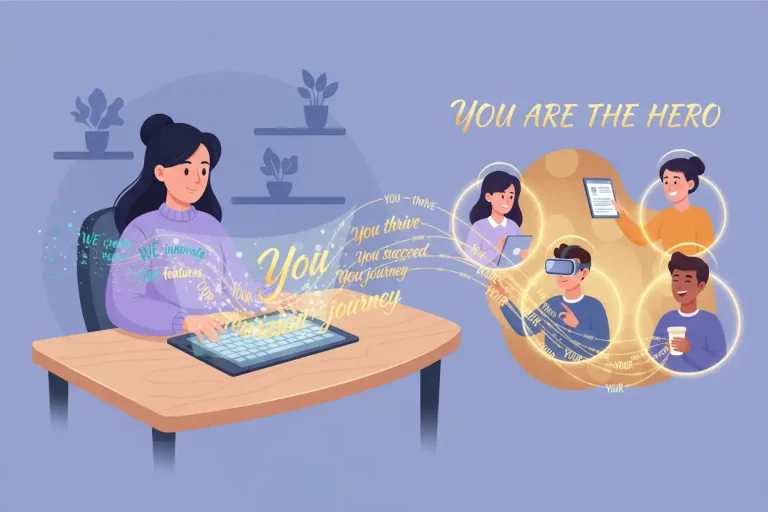
If you read most marketing copy aloud, it sounds like a company showing off in a mirror.
“We’re passionate about innovation.” “We’re proud of our people.” “We, we, we.”
Fair enough — you built something. But readers aren’t waiting for your autobiography; they’re waiting for their reflection. The real craft of copywriting lies in making the customer the hero of the story, not the brand.
Why “you” beats “we”
Copy laden with “we” sounds safe but self‑absorbed. “You”, on the other hand, opens the door. It shifts perspective from broadcast to conversation.
It’s the linguistic version of eye contact: it acknowledges presence. Instead of describing your brilliance, you describe the reader’s potential, pleasure or relief. People recognise themselves and lean closer.
Consider a simple swap:
- We‑centred: “We deliver world‑class time‑tracking solutions.”
- You‑centred: “You’ll finally know where your hours go — without a spreadsheet in sight.”
Same function, opposite focus. One shouts features; the other offers outcome.
The psychology of protagonism
We all filter the world through personal relevance. Neuroscientists call it the “self‑reference effect”: information tied to our own perspective gets stored and recalled better.
When your copy ignites that mechanism, memory and affinity spike. Customers don’t remember your service spec; they remember how your words made their own day look easier.
It’s also politeness. We live in a noisy world; choosing to speak in the reader’s direction signals respect for their attention.
The narrative shift: from actor to guide
Making the reader your protagonist doesn’t mean erasing your brand completely. You simply change roles — from hero to mentor.
In storytelling terms, you become the Gandalf, not the Frodo. The Yoda, not the Luke. You support, instruct and empower the customer to complete their own quest.
Donald Miller’s “StoryBrand” framework popularised this structure commercially, but the principle is ancient. Odysseus did the work; Athena steered the strategy.
So write as the brand that knows the shortcuts but still lets the reader hold the sword.
See it in action
Picture two travel‑insurance ads:
Version A: “We’re proud to offer 24‑hour emergency cover and industry‑leading response times.”
Version B: “Stranded at 2 a.m.? You won’t be. Your phone call reaches a real human within minutes.”
Version A talks about itself; Version B talks about your midnight anxiety and the comforting solution. Guess which one sells.
The best copywriters spend most of their time re‑framing sentences from internal pride to external relief.
How to retrain your copy instincts
- Count your pronouns. On your homepage, tally every “we/our/us” versus “you/your.” The ratio should lean dramatically towards the reader.
- Flip the subject. Wherever a sentence begins with your brand, ask: “Can the reader do this? Feel this? Benefit from this?” Then rewrite accordingly.
- Lead with empathy. Start from their pain‑point, not your process. “Sick of systems that crash mid‑deadline? Here’s one that won’t.” It’s small, but it changes everything.
- Use second‑person verbs. “You’ll see,” “you get,” “you can.” Each reinforces involvement, a sense of ownership.
Remember: attention is earned, not owed.
Tone without trope
“You‑fying” your copy doesn’t mean spraying cheerleader energy everywhere. Reader‑centred tone should feel invitational, not intrusive.
Instead of barking imperatives (“You must…!”), focus on gentle enablement: “You can…”, “You’ll find…”, “You’ll enjoy…”. Empowerment beats command.
Likewise, avoid false chumminess. A B2B cybersecurity firm doesn’t need emojis to sound human. Authentic empathy is quieter than that.
Checking the mirror
Before you publish a piece, run the mirror test: Does this copy endlessly describe us, or does it clearly imagine them?
Get a colleague outside marketing to read it. Ask them, “Who’s the main character here?”
If they say “you lot,” start again.
The irony? Making the customer the hero almost always makes the brand look better. People associate generosity of focus with confidence. A brand that doesn’t dominate the conversation feels like one that already knows its worth.
The takeaway
Brands obsessed with themselves fade into background noise. Brands obsessed with their audience become part of that audience’s story.
So next time you open a blank page, begin with these four words: “You’ve probably felt…” Build from there.
Because in modern marketing, the shortest path to being admired is to stop talking about yourself — and help someone else see themselves more clearly.