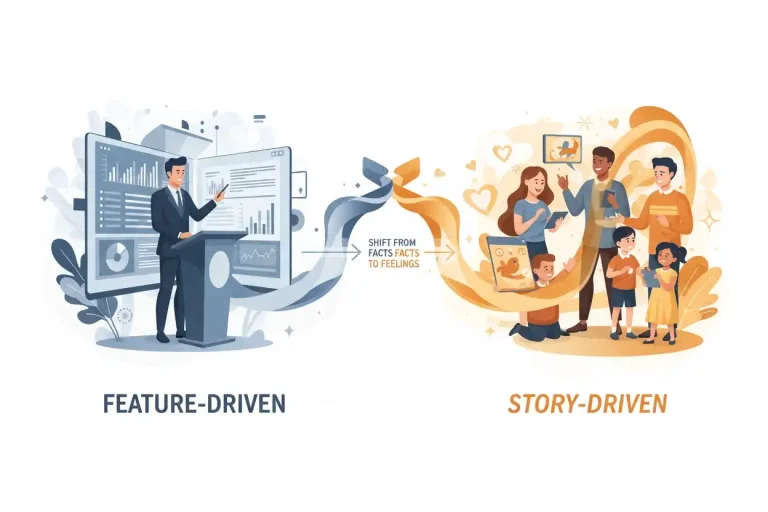
arketing has always had two tribes. One worships the product — lists features, diagrams benefits, quantifies superiority. The other focuses on story — how the product lives in someone’s world and changes it. Both claim science‑backed results, but only one tends to get shared, remembered, or smiled at.
Let’s unpack why story‑driven campaigns often outperform feature‑driven ones, and then look at a quick comparative case study to prove it.
What we mean by “feature‑driven”
A feature‑driven approach treats customers as rational buyers. It assumes purchase decisions are spreadsheets in disguise. You see this style in endless B2B websites: bullet lists, tech specs, numbers shouting louder than nouns.
There’s a tidy honesty in that logic — it tells the truth about what’s on offer. The trouble? Facts don’t live very long in memory. Without emotional context, even powerfully worded features evaporate the moment the scroll wheel spins.
Imagine two coffee ads.
- Feature ad: “15‑bar pressure, 25% faster heat‑up, double‑filter performance.”
- Story ad: “Morning. Grey light. One button, one rich smell, five quiet minutes to remember why you love your kitchen.”
Both are factual. Only one makes you feel.
Why stories work
Our brains process emotion long before logic. Narrative lights up more neurological regions — it triggers empathy circuits, helps recall, and even alters perception of value. People buy stories because they describe outcomes, not objects.
Think of stories as emotional frames. Whether you’re selling shoes or cloud software, story gives meaning to the why, not the what.
- Feature: “Real‑time data synchronisation.”
- Story: “Your team knows what’s happening the instant it happens.”
Same technology; very different heartbeat.
A short case study: two rival campaigns
A few years ago, a pair of small fitness‑app startups ran near‑identical ad budgets on social media. Let’s call them BoostFit and TrackPro.
TrackPro: the feature‑first route
TrackPro’s adverts listed measurements to two decimal places. Heart‑rate variability, calorie accuracy, AI algorithms, integration with eight wearables. Impressive stuff for athletes — but the click‑throughs were modest, conversions lower still. Comments mostly centred on price comparison.
BoostFit: the story‑first alternative
BoostFit instead built a mini‑narrative: a short video following an exhausted night‑shift nurse training for her first 5 k run. The app wasn’t the star; she was. The message closed with: “We’re all stronger than we think — we just need a nudge.”
Result? 3× higher engagement, more dwell time, twice the paid‑to‑free upgrade rate. The emotional lift translated straight into measurable action.
Those numbers aren’t magic. They’re psychology. BoostFit gave viewers someone to root for. TrackPro gave them data to file and forget.
Balance, not binary
That doesn’t mean you ditch every hard fact. Story minus substance is fluff. The art is in sequencing: lead with emotion, support with evidence.
Tell the why, then show the what. Let feelings open the door and facts close the sale. Apple does this flawlessly. “Shot on iPhone” tells a story about creativity first, megapixels later.
When buyers empathise, they don’t need you to justify features — they look for proof to validate feelings they already have.
Bringing story into feature‑heavy sectors
B2B and tech marketers often insist their audiences are too rational for stories. Rubbish. Decision‑makers are humans with inboxes and insecurities like anyone else.
A clever narrative doesn’t trivialise complexity; it humanises it. You can wrap a sophisticated message in a simple metaphor:
- “Our security software is your silent night‑watchman.”
- “Our logistics platform is the brain behind your supply chain’s muscle.”
These lines make the abstract tangible — which is precisely what stories are for.
How to test it yourself
Try this next time you draft an email or ad:
- Write a purely factual version — headline, bullet points, conclusions.
- Rewrite it as a tiny story about one person’s before → after.
- A/B test them. Watch which one travels further.
I’d bet your “story” tab wins on every soft metric (scroll time, CTR, recall). Even if conversions tie, the story version will leave a brand impression that outlives the campaign.
Takeaway
We don’t buy data; we buy the promise hidden inside it. Story‑driven marketing doesn’t ignore features — it just changes the spotlight. Facts support, feelings decide.
So next time you’re tempted to lead with another bullet list, remember our nurse from BoostFit. She wasn’t looking for stats; she was looking for stamina. Turn your next product sheet into her story, and you’ll earn something all the features in the world can’t buy: affection.