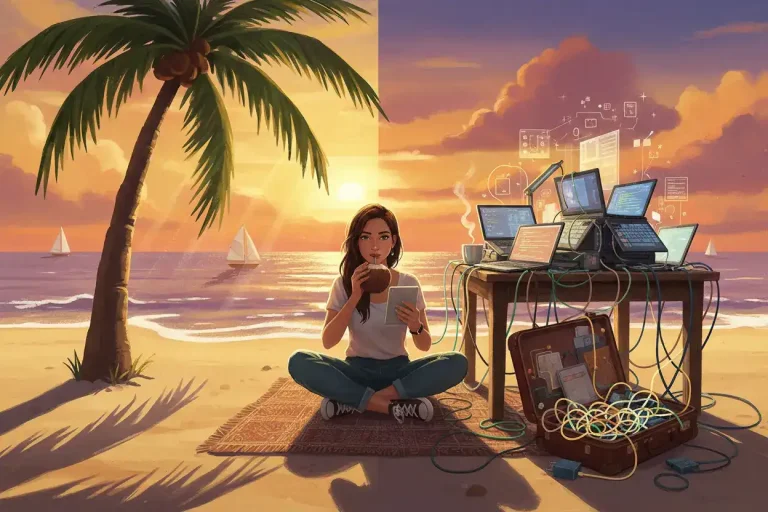
Once upon a broadband dream, “digital nomad” meant hammocks, laptops, and tax‑free smoothies. The fantasy looked effortless: work four hours from a Balinese villa, post sunrise gratitude reels, repeat. But a decade later, the myth has aged — beautifully filtered, yes, but frayed at the edges. Remote work is now mainstream; the nomad ideal is moodier. Was it freedom all along, or just office culture in flip‑flops?
The postcard and the invoice
The pandemic scattered millions of professionals into global Wi‑Fi zones, dissolving geography but not deadlines. Carry‑on entrepreneurship replaced corporate cubicles. Yet as the novelty wore off, digital nomad life revealed itself less as escape, more as administrative adventure.
Behind every sea‑view coworking space lies a spreadsheet of VPNs, invoice formats, and tax treaties. You may sip coconuts, but you’ll also Google “why client payment stuck in SWIFT limbo” before breakfast. For every Instagram post tagged #freedomlifestyle, there’s a migraine over international health insurance.
Freedom, it turns out, requires forms.
From fringes to workforce
The pre‑2019 nomad was fringe — a curiosity. Now millions operate remotely by default, even if they never leave their suburb. The aesthetic has gone corporate: Slack threads instead of surf breaks, Notion pages instead of notebooks.
That normalisation is progress. The stigma of “unserious sightseeing freelancer” has faded. Governments from Spain to Portugal now court nomads with visas and tax breaks; coworking chains treat them as core clientele. The world no longer asks how you work remotely, only from where.
But the question of why remains unsettled.
Freedom redefined
Early nomadism sold itself on geography: travel wherever, whenever. The new era of remote work has exposed a subtler freedom — freedom from the traditional hierarchy, not just the traditional office.
You may not wake up next to turquoise water, but you can choose clients whose ethics align with yours, arrange four‑day weeks, or log off when creativity flat‑lines. True autonomy isn’t locational; it’s operational.
The dream evolved from where you are to how you work while you’re there.
Productivity vs. performativity
Modern nomadism plays out on two screens: the work screen and the performative one. It’s a strange double life — project manager by day, travel vlogger by algorithmic necessity. The hustle for clients collides with the hustle for content.
Perpetual motion has become part of the personal brand, and exhaustion hides behind sunsets. Digital fatigue follows you through customs. Many veterans now choose what looks like heresy — settling down — not as failure but as upgrade. Stability became the new rebellion.
The logistics of lightness
Mobility still enchants, but it’s also expensive in hidden ways. Temporary housing costs linger, visas rotate, friendships loop in short seasons. Minimalism sounds romantic until you replace the same lost adapter in four countries.
Savvier nomads adapt by rooting temporarily: month‑long coworking residencies, shared resource hubs, hybrid travel schedules. They move like tides, not pinballs. The new equation is sustainability over spontaneity.
Community over coordinates
The surprise twist of the digital‑nomad decade is its anchor: people. What began as lone‑wolf independence matured into global micro‑communities — filmmakers in Chiang Mai, marketers in Lisbon, writers in Oaxaca.
Nomads learned what cities already knew: belonging matters. A reliable peer circle trumps an exotic backdrop. The modern “freedom lifestyle” often looks like a disciplined routine surrounded by kindred freelancers swapping client leads over bad coffee.
The hybrid horizon
With corporations embracing remote policy and border policies easing, the next wave of nomads will blend stability and movement. Expect “base cities” — affordable capitals used as hubs with regular travel chapters. Nomadism 2.0 emphasises rhythm over randomness: three months here, two there, a pause for taxes somewhere sensible.
The fantasy of infinite travel has been replaced by something more mature — portable professionalism. The new dream: competence with a view.
The takeaway
After a decade of Wi‑Fi wanderlust, the digital nomad reality isn’t paradise lost; it’s adulthood gained. The community has matured from escapists to experts — people designing their work to amplify life instead of fleeing it.
Freedom was never the beach; it was the brief. The secret all along wasn’t running away — it was writing your own schedule and meaning it.