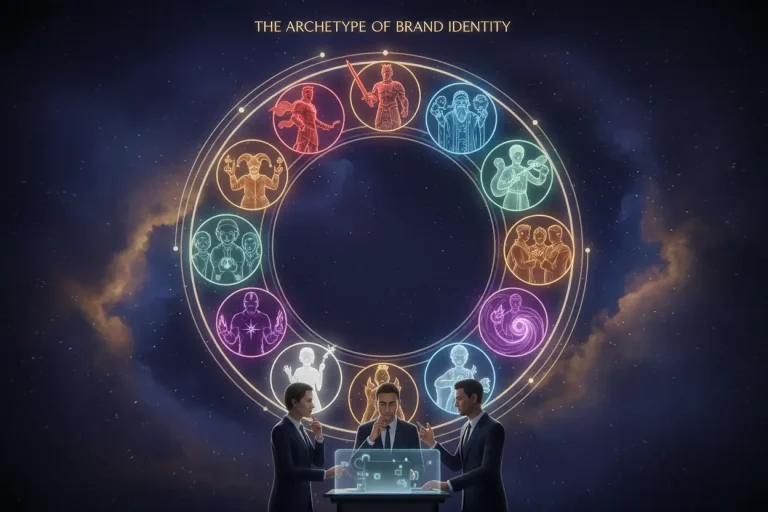
Most brands talk about “tone of voice”, but tone is only half the equation. The deeper question is: who’s speaking? To create a brand people recognise instinctively, you need a consistent character — one that thinks, feels and behaves in a way your audience can anticipate. This is where brand archetypes come in.
What exactly is a brand archetype?
The theory hails from Swiss psychologist Carl Jung, who noticed recurring character patterns in myths and storytelling — the Hero, the Explorer, the Caregiver, and so on. These aren’t stereotypes; they’re psychological shorthand. They let people quickly grasp what kind of energy you’re bringing to the table.
Marketers borrowed the idea and ran with it. Suddenly, brands became capable of more than selling — they could embody a role in customers’ lives. Nike became the Hero spurring us to push limits. IKEA played the Everyman making style accessible. Dove transformed into the Caregiver, championing authenticity and self‑esteem.
These archetypes help define not just what you say, but how you make people feel when you say it.
Why archetypes stick in the mind
Human beings crave coherence. We trust what we can predict. When a brand consistently strikes the same emotional note, it starts to feel like a person — and it’s people we build relationships with, not product catalogues.
For smaller businesses, this is gold dust. You can’t compete on scale, but you can absolutely compete on identity. If your communications always sound like the same “character”, people begin to develop loyalty out of familiarity.
Imagine walking into a shop where every staff member greets you with the same quiet humour and unhurried helpfulness. You trust the experience before you’ve even looked at the shelves. Archetypes work the same way — they make your brand behaviour feel deliberate.
How to define your archetype
Start by looking beyond demographics and instead at motives and values — yours and your audience’s.
- List your natural traits. Are you talkative or measured, daring or careful, rebellious or nurturing?
- Identify what your audience wants emotionally. Safety? Adventure? Prestige? Belonging?
- Find the overlap. That intersection points toward your archetype.
A quick sampler of common ones:
- The Hero: Motivated by challenge and triumph. Inspires others to act.
- The Explorer: Values freedom and discovery. Promotes curiosity.
- The Caregiver: Nurtures, protects, reassures.
- The Jester: Brings fun and relief in serious categories.
- The Sage: Offers wisdom and clarity.
- The Rebel: Challenges norms; operates on bold honesty.
- The Lover: Prioritises connection, beauty, intimacy.
You’ll sometimes see twelve‑ or even twenty‑four‑archetype lists, but don’t overthink it. One clear direction beats a Wikipedia of possibilities.
Mixing isn’t evil — but moderation matters
Many brands exhibit a primary and secondary archetype. For example, Innocent Drinks blends the Jester (playful tone) with the Caregiver (healthy choices). Patagonia mixes Explorer (adventure) with Sage (environmental wisdom).
But resist the “personality buffet” where you grab three of each because they sound nice. Mixed messages equal mixed emotions, and that quickly translates into mixed trust. Within your storytelling team, get everyone on the same page: this is who we are, this is how we express it.
Bringing archetypes to life
Once chosen, the archetype needs to ripple through everything — not just a paragraph on your brand book.
Visual design: A Rebel won’t hide behind muted greys; a Lover brand probably shouldn’t be shouty neon.
Copywriting: The Caregiver comforts; the Hero commands; the Sage teaches.
Customer experience: From hold music to refund emails, consistency in attitude builds authenticity.
Ask yourself with every decision: “Would our character do this?”
When people sense congruence between your words, visuals and actions, they file you mentally under trusted, even if they couldn’t name why.
Evolving without losing yourself
Archetypes aren’t cages. They’re foundations. Brands evolve — Heroes retire, Sages become Explorers — but the emotional root should stay recognisable. Think of it like a person ageing: the wardrobe changes, but the essence remains.
If you ever rebrand, use your existing archetype as the through‑line. Keep the same core need you serve, even if you update the design language around it.
The takeaway
Your brand’s archetype is the emotional fingerprint people feel when they interact with you. It’s how they interpret your jokes, your colours, your promises. Get it right, and you’ll never sound like “just another business” again. You’ll sound like a character they already know — and, better still, one they’d like to keep around.