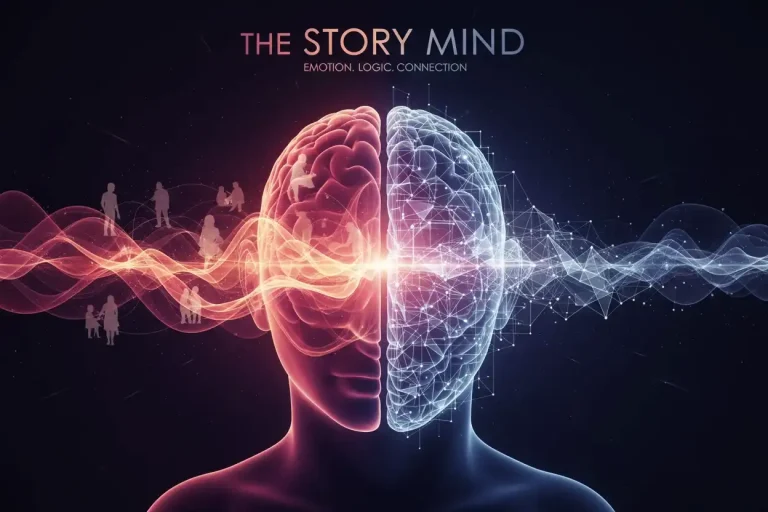
Behind every polished campaign deck lurks a simple biological fact: people do not buy through logic first. They buy through feeling, then let logic tidy up afterwards. Stories are the software that emotion runs on; they’re how our brains compress chaos into meaning.
In behavioural marketing, storytelling isn’t art direction — it’s neural engineering.
1. The brain that prefers fiction
Studies from Princeton’s NeuroHumanities Lab show that when we hear a story, our brains synchronise with the storyteller’s — activating not only language centres but sensory and motor cortices, as if we were living the tale. Facts inform; stories simulate. That internal mimicry explains why emotion‑laden narratives outperform feature lists every time.
2. Emotion as data carrier
Antonio Damasio’s research on patients with damaged emotion centres revealed they could articulate logic perfectly yet couldn’t decide even lunch. Emotion is how the brain weighs importance. A dry claim floats away; an emotional frame sticks because your amygdala tags it as “store for survival.” Great marketing transmits data through feeling, not despite it.
3. From attention to empathy
Story activates oxytocin, the “trust molecule.” When tension rises and resolves, we literally feel connection. One field experiment showed donations jumped over 60 percent when charity appeals told a single person’s story versus pure statistics. Narratives shrink scale until compassion fits inside it.
4. Conflict is the carbohydrate
Our brains metabolise contrast. Without struggle, attention drifts. But modern marketing mistakes drama for distress. The best brand stories frame tension as shared challenge: moving from confusion to clarity, fear to agency, chaos to flow. Let customers be protagonists; your product is merely the mentor or tool that helps them cross the bridge.
5. The arc people can walk
Classic narrative structure mirrors brain chemistry:
1. Setup – equilibrium (dopamine calm)
2. Conflict – uncertainty (cortisol spike)
3. Resolution – reward (oxytocin + serotonin)
Good marketing sequences mirror that arc across micro‑moments — educational hook, empathetic tension, satisfying solution. In shorthand: tell to teach, teach to trust.
6. Visuals as emotion shortcuts
Images and colour hit the limbic system 600 times faster than text. Blue calms; red alerts; warm neutrals comfort. Photography and illustration are not decoration but pre‑verbal persuasion. A story begins visually before a word is read — agree the emotion first, then draft accordingly.
7. Consistency creates emotional echo
The hippocampus builds memory through pattern recognition. When tone, palette, and promise stay steady across platforms, the emotional imprint grows stronger each time. Inconsistency resets memory; constancy deepens it. Storytelling isn’t just the content — it’s the rhythm of remembering.
8. Logic as post‑purchase comfort
Logic still matters; it rescues pride after emotion spends money. Immediately after a purchase, the neocortex hunts for reasons: reviews, quality, guarantees. Wise marketers supply those rational props early, turning guilt into justification. The heart buys; the head retains self‑respect.
9. Vulnerability invites trust
Audiences mirror authenticity. A brand that admits imperfection (“We got feedback — and fixed it”) humanises itself neurologically; the prefrontal cortex relaxes defensive bias. Honest flaws signal honesty overall, making future persuasion easier. Perfect companies feel inhuman; slightly flawed ones feel alive.
10. Story as shared identity
Great storytelling transforms spectators into participants. When your story reflects the audience’s values, every retweet becomes co‑authorship. People don’t repeat slogans — they repeat self‑descriptions. Design narratives that let them finish the sentence: “People like me…”
## The takeaway
Emotion moves; logic maintains. The smartest strategy isn’t choosing between them but sequencing them: feel first, justify later. Brands that speak in story form translate features into feelings and value into memory.
Because memory, not message, is what marketing ultimately buys.