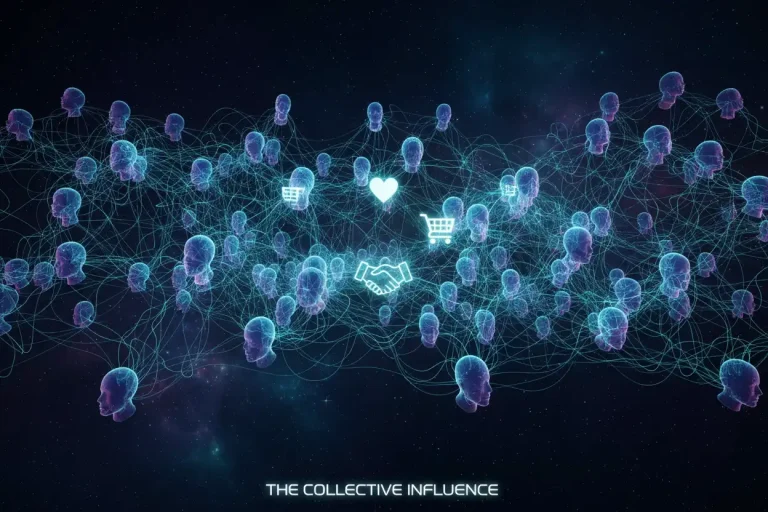
Even when a buyer sits silently before a screen, a crowd of invisible influences hums behind the decision: peers, tribes, norms, and validation loops. We are social creatures with marketing receptors calibrated for belonging. Behavioural marketing’s most powerful truth might be this: persuasion isn’t individual — it’s collective permission.
1. We’re wired for others
Neuroscientists call it the social brain network — regions that light up for empathy, mimicry, and moral judgment. Our survival once depended on reading the group, so approval still feels like oxygen. Marketers who ignore this design speak to isolated egos; those who get it communicate to connected selves.
2. Mirror neurons and mimicry
When we see someone use a product with satisfaction, the same neural patterns fire in our heads. That’s not metaphor — it’s mirror‑neuron activation. It’s why testimonials and demos outperform specs, and why influencer marketing works (until it fakes authenticity). Show real people experiencing real value; the brain copies feeling faster than it reads facts.
3. Social proof isn’t peer pressure
Robert Cialdini codified the bias: we look to others to decide what’s correct. But there’s nuance. Normative influence: fitting in. Informational influence: learning from. Healthy marketing nurtures the second. “Here’s what people like you discovered” informs; “Everyone’s doing it” manipulates. The line is empathy — flattery without coercion.
4. Identity signalling
Every trend doubles as tribe signal. A reusable mug, gaming console, or software badge tells a social story: “I belong with them.” Marketers who frame belonging aspirationally but authentically convert faster because they invite self‑expression, not conformity. Brand communities work when identity is discovered, not prescribed.
5. The network halo
Emotion is contagious. Positive sentiment shared publicly multiplies perceived trust up to three social degrees (researchers literally measured it). A single delighted tweet can outperform a paid ad because it travels through belief networks, not algorithms. Encourage shareable pride moments — unboxing, milestones, thank‑yous. Give audiences reasons to brag kindly.
6. Reciprocity and the human debt loop
Our ancestors survived on reciprocal cooperation: “I help you, you help me.” That wiring still drives conversions. Free value before ask — guides, generosity, small wins — triggers gratitude, not guilt. When reciprocity feels unpaid yet genuine, communities self‑propagate.
7. Loss of face and risk aversion
Humans fear social loss more than monetary loss. It explains why reviews dominate decisions. A negative rating threatens a buyer’s future belonging (“Will people think I chose badly?”). Protect your customers’ public dignity: clear guarantees, responsive service, humble correction. They forgive error; they don’t forgive embarrassment.
8. Humour as tribal glue
Laughter synchronises breathing, literally synchronising groups. When your brand uses wit that audiences recognise as “our kind of funny,” oxytocin spikes — trust hormone included. Avoid punchlines that require victims; humour should build circles, not walls.
9. Communities as co‑marketers
Behavioural marketing ends where community marketing begins. Turn social energy semi‑autonomous: let customers teach, moderate, or champion. User‑generated content isn’t cheap labour; it’s identity ritual. People defend what they help build.
10. The moral of the crowd
The same group instincts that build fandoms can fuel mob behaviour. Algorithms reward outrage because outrage bonds tribes quickly. Marketers must choose slower chemistry: curiosity, creativity, joy. If your campaign unites through uplift rather than opposition, it stands the test of time and Twitter.
## The takeaway
The brain is social hardware running modern software. We learn, buy, and believe together. Behavioural marketing in its kindest form recognises that every click is a group act — one person signalling to many unseen minds. Design your message so that when someone shares it, they’re not just broadcasting you; they’re expressing who they are among others.