There’s a fine line between delightfully contagious and aggressively clingy. Viral growth once meant “get users to invite other users at any cost.” For a few years, the internet became a carnival of trick buttons and guilt modals: “Are you sure you want to miss out forever?” Eventually everyone clicked “yes.”
In 2025/26, virality isn’t about manipulation; it’s about alignment. True viral loops don’t hijack behaviour — they reward enthusiasm already there.
The anatomy of a loop
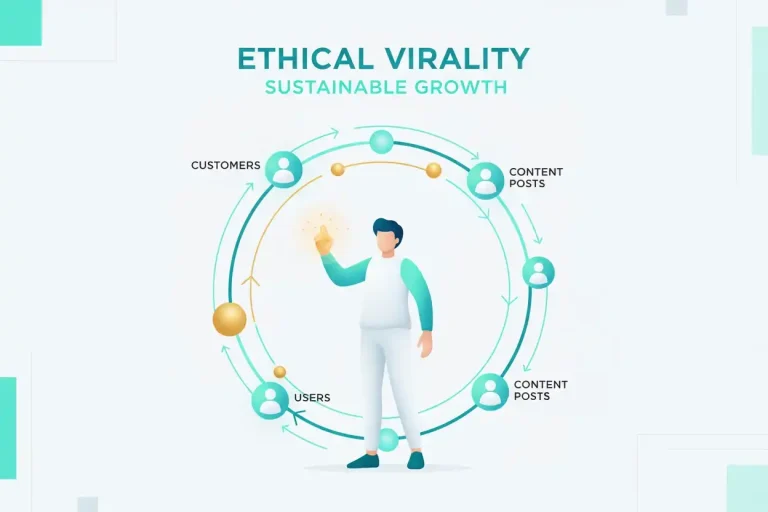
A viral loop forms whenever one user’s natural action generates exposure to new users who then perform the same action. Classic example: invite friends → friend joins → friend invites more. It’s exponential empathy when done well, exponential embarrassment when done poorly.
The simplest equation:
Value for me + Visibility to you + Ease of sharing = Sustainable loop.
Remove or distort any variable and you get junk virality instead — churn disguised as growth.
1. Every share must solve a user problem
People only spread utilities that make them look or feel good. Dropbox’s historic referral scheme worked because both sides won storage. Likewise, Calendly links solved logistical headaches, not marketing goals.
The viral moment should enhance the user’s sense of competence. If sharing feels like advocacy rather than advertisement, you’ve built a loop, not a chain letter.
2. Design gratitude, not bribery
Incentives that feel transactional expire quickly. “Invite three friends, earn points” trains mercenaries. Instead, reward generosity and shared identity — badges, early access, community visibility. Humans chase reputation more passionately than coupons.
A great referral design follows this psychological triad:
affirmation → amplification → appreciation —
users feel proud, the act is visible, and the brand says thank you authentically.
3. Make friction invisible
Virality collapses under extra clicks. Every modern product that spreads effectively distills the invite path to seconds. Embedded share cards, one‑tap deep links, QR handshakes at events — effortless generosity.
Test your loop on your least tech‑savvy relative; if they succeed unfrustrated, you’ve achieved product empathy.
4. Build stories, not scripts
Users love to attach meaning to what they share. Craft shareable assets worth showing off — playful data summaries, personalised milestones, mini‑achievements. Spotify Wrapped turned private listening into public theatre. Strava’s weekly summaries made fitness social currency.
Storytelling generates organic virality because it flatters individuality while promoting the platform. The psychology: “this is me, powered by them.”
5. Ecosystem over exit pop‑ups
Viral loops thrive when the product already connects communities — developer APIs, marketplaces, design templates, public dashboards. Each new artefact breadcrumbs potential users back to origin. Figma didn’t nag for referrals; it built a collaborative file format that carried its logo everywhere.
If exposure feels woven in, users stop calling it marketing.
6. Leverage curiosity, avoid coercion
Scarcity, countdown timers, forced social logins — the dark‑pattern era of virality fell apart because it disrespected consent. Curiosity is stickier than fear. Teasers revealing partial results (“Top 5 creators this week — are you on the list?”) invite opt‑in intrigue without guilt.
Emotional rule of thumb: viral design should provoke delight or FOMO’s polite cousin, anticipation.
7. Use analytics to protect dignity
Measure not only invitations sent but conversions per friendship. If ratios sink, you’re abusing goodwill. Healthy loops show stable engagement and low complaint rates. Run qualitative check‑ins: “How did sending invites feel?” — a sentence that separates reputation builders from spam factories.
Long‑term growth is social capital compounding. Once trust erodes, it rarely re‑shares.
8. Let humans be the algorithm
Marketers still fantasise about automation, but communities outperform code. Peer‑led ambassador programmes, niche influencers, loyal‑customer highlight reels — these operate as emotional APIs. Human passion scales slower but decays slower too.
Think “earned echo” rather than “engineered push.”
9. Post‑share gratitude loops
Closing the circuit keeps virality alive. Send brief thank‑yous, acknowledge top referrers publicly, offer sneak previews. Each expression of appreciation reinforces behaviour without sleaze. It’s behavioural economics wearing good manners.
The vibe test
Before launching any referral mechanic, ask three blunt questions:
1. Would I share this naturally?
2. Would my friend thank me or roll their eyes?
3. Would removing the incentive reduce sharing entirely? If yes, redesign from trust upward.
The takeaway
Viral magic isn’t found in dashboards — it lives in empathy and timing. Give users something worthy of pride and tools worthy of ease. When a product’s invitation feels like a favour rather than a funnel, growth becomes sustainable folklore.
The most infectious thing on the internet, it turns out, is respect.