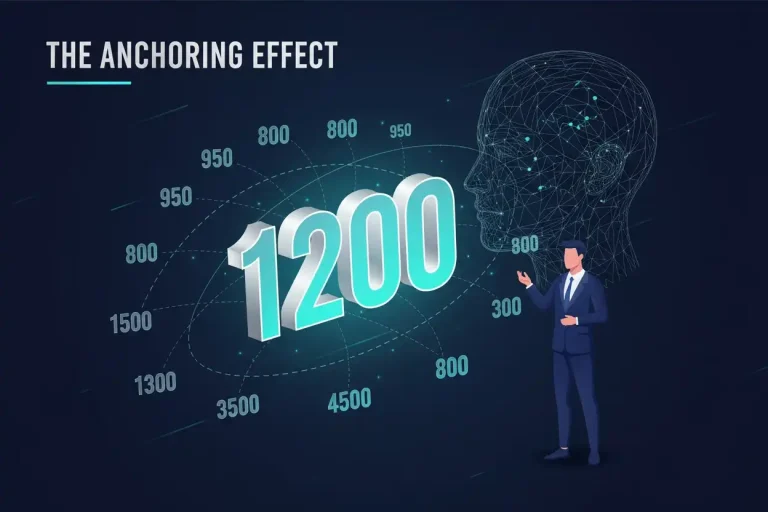
Ever wondered why £79 suddenly feels cheap after you’ve seen £149? That’s not luck—it’s anchoring. One of marketing’s simplest yet most powerful psychological effects, anchoring is how the first price customers see silently dictates their perception of value. Whether it’s a luxury bag or a streaming subscription, the “first number” quietly frames every comparison that follows.
This guide covers psychology, why first impressions matter, classic tactics, backfires, ethical use, tools, real-world examples, and the golden rule. By the end, you’ll anchor prices to boost conversions ethically. Let’s set the stage.
Step 1: The Psychology of Anchoring
Anchoring is a cognitive bias where people rely too heavily on the first piece of information they encounter when making decisions. In pricing, that anchor becomes a mental yardstick. See a £500 watch before a £200 one, and the second feels like a bargain. Reverse the order, and £200 suddenly seems steep.
Our brains crave shortcuts when assessing value. Instead of evaluating worth objectively, we compare. Anchoring supplies that reference point, reducing uncertainty—and often steering us toward what marketers want us to choose.
Step 2: Why First Impressions in Pricing Matter
Humans don’t process prices in isolation. We assess differences. Research from behavioral economists shows that anchored pricing can raise conversion rates by 20–30% compared to neutral, standalone pricing.
Even large retailers rely on this bias. When J.C. Penney attempted “everyday fair pricing” in 2012—removing strike-through “Was 40,Now40, Now 40,Now20” tags—sales plummeted. Without an anchor, shoppers lost context. £20 felt expensive because there was no £40 reference to signal value.
Step 3: Classic Anchoring Tactics
High-Low Pricing:
The most common play: list an inflated “original” or “recommended” retail price, then show your offer as a discount. That higher starting number anchors perception, making the reduction feel like a reward.
Tiered or “Good-Better-Best” Pricing:
Offering three options lets the anchor do the work. Most customers land on the middle tier—avoiding the cheapest (too risky) and the top tier (too pricey). It’s not coincidence; it’s cognitive comfort.
Premium Decoys:
Insert an intentionally overpriced product to make your target price seem modest. A “decoy” £999 espresso machine makes the £599 model fly off shelves.
Order Presentation:
Online stores that display the most expensive option first benefit from the contrast halo. The high anchor sets the mood: subsequent prices seem smaller, even if unchanged.
Step 4: When Anchoring Backfires
Anchoring can easily slip into manipulation if customers sense dishonesty. Repeated fake discounts—like perpetual “75% off” offers—erode credibility. Transparent value framing works better: offer context (premium materials, expert design, longer warranties) to justify the initial anchor and rebuild trust.
Step 5: How to Use Anchoring Ethically
- Lead with the premium option, not the sale. The first price should reflect genuine top-tier value.
- Show contrast, not deceit. Display ranges side-by-side so customers can self-justify decisions.
- Explain the anchor. Context (“priced at £499 RRP”) turns the higher figure into verified reference, not hype.
- Test and adjust. Use A/B data to find your optimal first-price exposure and avoid consumer fatigue.
Step 6: Tools to Perfect Your Anchors
- VWO Testing Suite: Run multivariate tests on initial price order and discount framing.
- Price Intelligently by ProfitWell: Analyse elasticity and find the best anchor thresholds.
- Psychological Pricing by Shopify: Simulate how price ladders change perception at checkout.
- Convertize: Automates A/B anchor tests and personalised price sequencing.
- Competera AI: Uses market data to set dynamic anchor prices aligned with competitors.
Step 7: Anchoring in the Wild
Luxury brands thrive on anchoring. The £1,200 coat on display isn’t expected to sell—it exists to make the £699 one look sensible. Restaurants list £90 wine bottles not to move stock, but to make the £45 one feel balanced. Anchors, when placed right, whisper “value” before the customer even reads the fine print.
Wrap-Up: Anchoring’s Golden Rule
Your first number frames your story. Done well, it doesn’t trick—it clarifies. Anchoring transforms confusion into confidence, turning “That’s expensive” into “That’s worth it.”
In pricing, perception is reality—and the anchor writes the opening line.