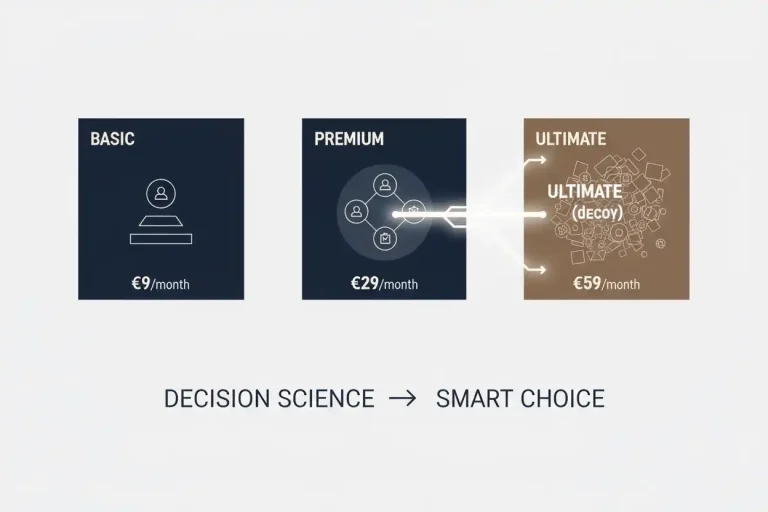
Imagine choosing between a small coffee for £2.99 and a large for £7.99. Most people pick the small one. Now add a “medium” for £6.99—suddenly, the large feels like incredible value. That irrational nudge is the Decoy Effect, and it’s quietly shaping decisions from cinemas to SaaS subscriptions.
This guide defines the Decoy Effect, explains how it works, real-world examples, why customers fall for it, ethical use, tools, and the fine art. By the end, you’ll deploy decoys for smarter choices that convert. Let’s decoy wisely.
Step 1: What Is the Decoy Effect?
The Decoy Effect (or asymmetric dominance bias) occurs when adding a third, strategically priced option steers customers toward the one you want them to buy. The decoy itself is rarely meant to sell—it exists to make another choice look better.
Think of it as value framing through contrast. When a “lesser” alternative sits beside a premium option for nearly the same price, the premium suddenly feels logical—even frugal.
Dan Ariely’s classic Economist experiment popularized it:
- £59 for online-only access
- £125 for print-only
- £125 for both
No one picked print-only. But its presence made £125 for “both” feel like the ultimate deal. When he removed the decoy, most reverted to the £59 option.
Step 2: How It Works in the Real World
Fast Food & Retail:
Cinemas price medium popcorns just below large ones to push upgrades. The £6.50 bag exists purely to make the £7 version irresistible.
Subscription Models:
Most digital brands offer three plans: Basic, Standard, Premium. The middle or top tier is often the target. Netflix and Spotify have used decoy tiers to tilt adoption toward higher packages without explicit upselling.
Luxury Retail:
High-value decoys reframe perception. A £4,000 handbag makes the £1,900 model appear “reasonable”—the decoy sets a new reference point for value.
Bundled Services:
A spa offering “Basic £50, Premium £90, Deluxe £95” uses the deluxe as a decoy to make the £90 option look balanced, neither cheap nor excessive.
Step 3: Why Customers Fall for It
The Decoy Effect works because it resolves decision discomfort. Faced with complexity, the brain looks for a shortcut—relative value. When comparisons are easy to justify (“£1 more for double the features”), rational control gives way to emotional self-persuasion.
It also creates a sense of competence. Choosing the “better deal” lets customers feel smart—like they’re out-thinking the system.
Step 4: Using the Decoy Effect Ethically
The line between persuasion and manipulation is thin. Responsible marketers use decoys to clarify—not confuse—value.
- Keep all offers genuine. The decoy shouldn’t be fake or meaningless; it must deliver proportional utility.
- Test perception. Use behavior analytics to ensure buyers still feel satisfied post-purchase.
- Avoid perpetual decoys. If the same offer always seems “limited,” customers notice the trick over time.
- Add context. Explain who each option suits best (“Designed for teams” vs. “For individuals”). This reframes choice as guided alignment, not coercion.
Step 5: Tools to Design and Test Decoys
- VWO or Convertize: Run A/B tests comparing 2-tier vs. 3-tier pricing pages.
- ProfitWell Price Intelligently: Find thresholds where upgrades increase without spiking churn.
- Shopify Pricing Apps: Build visible comparisons showing per-feature differences.
- Hotjar Heatmaps: Analyse where customers hover or hesitate between price tiers.
- Competera AI: Model dynamic decoy pricing based on real-time demand data.
Wrap-Up: The Fine Art of Framing
Used ethically, the Decoy Effect doesn’t deceive—it simplifies. It highlights hidden logic, guiding customers to choices that fit their needs and your margin goals.
But overplayed, it erodes trust fast. The key is empathy—structure your pricing not to trick but to clarify value hierarchy. After all, persuasion that respects intelligence earns loyalty long after the sale.
Done right, a decoy isn’t deception. It’s choreography—guiding customers smoothly toward a decision that feels like their own.